
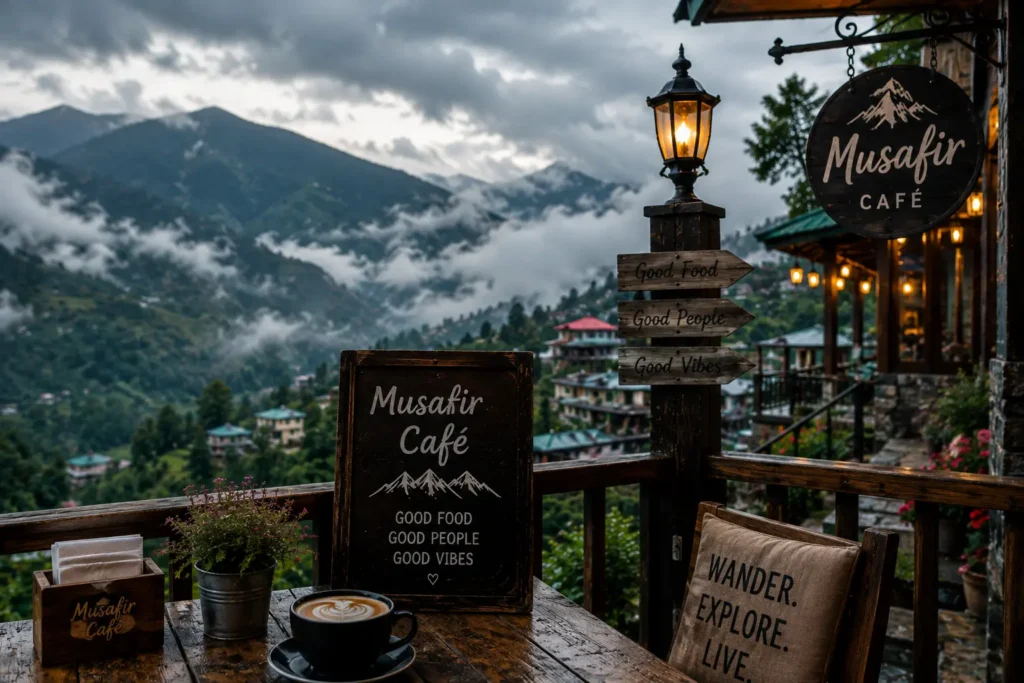
Musafir Cafe: The Little House That Waits at the End of the Road
There are places in the Himalayas that don’t appear on any map, and Musafir Cafe is one of them.
You won’t find it by searching “best cafes in Uttarakhand.” You’ll find it the way most good things in the mountains are found — by accident, by a wrong turn taken on purpose, or because someone in a bus, a dhaba, or a shared taxi leaned over and said, “Bhai, if you’re tired of the crowds, go to Musafir. Tell them Bittu sent you.”
This is the story of that place. Of the people who built it, the travellers who stumbled into it, and the mountain that watches over all of them.
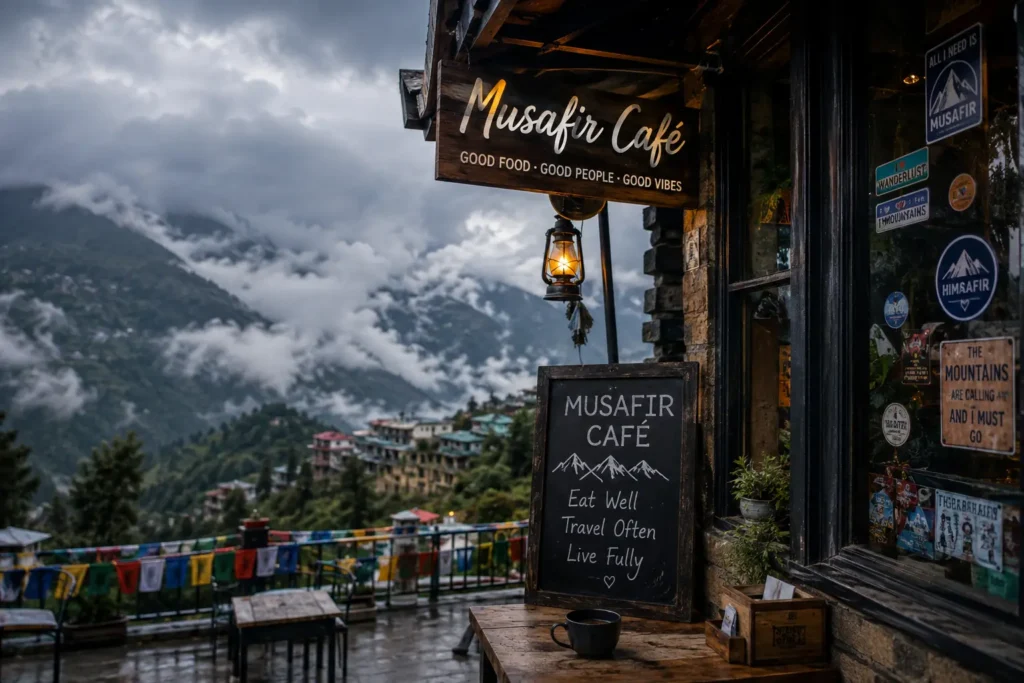
The Road That Forgets You
To reach Musafir Cafe, you first have to leave the highway behind — the one choked with honking Innovas and tour buses draped in marigold garlands, all racing toward the same five hill stations everyone has already seen in someone else’s Instagram reel. Somewhere past the last fuel pump, where the network bars on your phone quietly disappear one by one, a narrow mule track breaks off from the main road and begins to climb.
It isn’t signposted. There’s just a weathered wooden plank nailed to a deodar tree, the letters painted by hand in fading red: मुसाफिर कैफे — 3 km. Musafir Cafe.
The track climbs through a forest of oak and rhododendron, past terraced fields where old women bend over mustard crops, past a spring where the local shepherds water their goats. The town noise — the diesel generators, the loudspeakers, the constant urgency of “please hurry, checkout is at 11” — fades with every step, replaced by wind moving through pine needles, which sounds, if you listen carefully, almost like breathing.
And then, just when your legs have started to ache and you’ve begun to wonder if the plank was a joke played on unsuspecting tourists, the trees part.
There it is.
The House on the Ridge
Musafir Cafe sits on a spur of the ridge like it grew there rather than was built — a low stone-and-wood structure with a slanting slate roof, smoke curling lazily from a tin chimney, and a garden of dahlias and marigolds fighting for space with wild ferns. Prayer flags are strung between two apple trees, snapping gently in the wind. Beyond the low wooden fence, the land simply falls away — into a valley of terraced fields, then forest, then a haze of blue ridgelines stacked one behind another until they dissolve into the sky. On a clear morning, if you’re lucky and the clouds cooperate, you can see the white line of the high snow peaks in the far distance, sitting there like a promise.
There’s a hand-painted board near the entrance that has become something of a local legend among the handful of travellers who’ve found this place:
“Yahaan koi mehmaan nahi hota, sirf musafir hote hain — jo aata hai woh apna ho jaata hai.” (Here, no one is a guest — only a traveller, and every traveller becomes one of our own.)
The cafe itself is small — six wooden tables, mismatched chairs collected over years from different corners of the hills, a stone fireplace that’s rarely allowed to go cold between October and March, and shelves crammed with books left behind by travellers who promised to return for them and never quite did. Above the fireplace hangs a large handwoven rug in deep reds and blacks, a gift, they say, from a Bhutia trader who stayed here once for a week when he meant to stay a night.
Attached to the cafe, up a short flight of stone steps, are four homestay rooms — simple, wood-panelled, each with a window that frames the valley like a painting nobody could ever quite capture with a camera. There’s no Wi-Fi. There’s a single charging point in the common room, shared on an honour system. And somehow, nobody minds.
Kunwar Da and Devki Aunty
The cafe belongs, in every sense that matters, to a couple everyone simply calls Kunwar Da and Devki Aunty.
Kunwar Da used to work in Delhi, in a job he describes now only as “bahut confusion wala kaam” — something in logistics, spreadsheets, endless meetings about meetings. He’ll tell you, if you ask over a second cup of chai, that the year his father passed away, he came back to the family’s ancestral land for the cremation and simply never left. “Main sochta tha main pahad chhod kar bhaag raha hoon,” he says. I used to think I was running away from the mountains. “Baad mein samajh aaya, main sheher se bhaag raha tha, pahad ki taraf.” Later I understood — I wasn’t running from the mountains. I was running toward them, away from the city.
Devki Aunty grew up two villages over, the daughter of a schoolteacher, and married into the family long before the cafe existed — back when this land grew only potatoes and rajma, and the old stone house on the ridge was simply where the family stored fodder for the winter. It was her idea, everyone insists, though Kunwar Da likes to take equal credit after his second rum on cold nights. She’d fed one too many exhausted trekkers who’d lost their way looking for a shortcut trail, fed them rajma-chawal and hot ginger tea without asking for a rupee, and one of them — an architecture student from Bangalore, if the story is to be believed — said, half joking, “Aunty, yeh toh ek café hona chahiye.” This should be a cafe.
Nobody remembers exactly when the joke became real. But slowly, room by room, table by table, the old fodder-store became Musafir Cafe — built with local stone, local wood, and absolutely no plan beyond making sure nobody who arrived tired and hungry ever left that way.
The Menu, and What It Really Serves
The food at Musafir Cafe is deceptively simple. There’s no laminated menu with a hundred confusing options. Devki Aunty cooks what the season gives her — steaming bowls of jhangora ki kheer on cold evenings, gahat ki dal thick enough to hold a spoon upright, aloo ke gutke fried with mountain herbs whose names exist only in the local dialect, and always, always, a pot of chai brewing on the wood stove, spiced differently depending on her mood.
But regulars — and there are more of them than the cafe’s remote location would suggest — will tell you the real thing being served at Musafir isn’t on any plate.
It’s stillness.
It’s the particular quality of silence you get at seven thousand feet, broken only by a woodpecker somewhere in the oak forest, or the far-off bark of a village dog, or Kunwar Da’s transistor radio playing old Kishore Kumar songs low enough that they become part of the wind rather than competing with it.
Guests who arrive stressed — and most do, carrying the residue of traffic jams and deadlines and phones that buzzed the entire way up — find that something in them slows down by the second evening. They stop reaching for their phones every few minutes. They start noticing things: the exact moment the light turns gold on the far ridge, the sound rain makes on a slate roof, the taste of tea that hasn’t been rushed.
Stories the Walls Have Collected
Ask Kunwar Da for stories and he’ll pour you another chai and settle into the chair by the fireplace like a man about to enjoy himself.
There was the young couple from Mumbai, newly married, who arrived after a fight so loud the taxi driver refused to wait for them at the trailhead. They checked into separate rooms the first night. By the third evening, they were sitting together on the wooden bench outside, watching the sunset in complete silence, hands quietly finding each other again. They still send a card every Diwali.
There was the retired army officer who came alone, said almost nothing for two days, and on the third morning helped Kunwar Da repair a section of the stone fence without being asked, working in silence until his hands were raw. Before he left, he simply said, “Yahaan aakar lagta hai main abhi bhi zinda hoon.” Coming here, I feel like I’m still alive. He never explained further, and nobody asked.
There was the group of college friends who arrived loud and left quiet — not sad-quiet, but the kind of quiet that comes from four days without notifications, spent instead playing cards by lamplight and arguing about nothing that mattered.
And there was the woman — this story Devki Aunty tells, not Kunwar Da — who came alone one monsoon with a small urn wrapped in a shawl. She stayed a week, said very little, and on the last morning asked Devki Aunty to walk with her to the ridge above the cafe, where the wind is strongest and the view opens up toward the far snow line. She scattered her father’s ashes there, into the wind, and thanked the mountain out loud, as if it were a person. Devki Aunty still keeps a small brass diya lit near that spot every evening.
These aren’t dramatic stories. They’re not meant to be. They’re the quiet, accumulated proof of what a place like Musafir Cafe actually does — not entertain you, but return you to yourself.
A Day at Musafir
If you stay, your days will fall into a rhythm that feels almost old-fashioned in how little it demands of you.
Mornings begin early, whether you plan them to or not — the light through the wooden shutters and the smell of woodsmoke see to that. Devki Aunty will already be at the stove, and the first chai of the day, drunk on the stone veranda while the valley below is still half-hidden in mist, is reason enough to have made the journey.
Most guests spend the mornings walking — there are trails that loop through the oak forest to a small Devi temple twenty minutes away, or a longer trek to a waterfall that’s barely a trickle by April but roars by August. Kunwar Da will draw you a rough map on a paper napkin if you ask, and it will somehow be more accurate than Google Maps.
Afternoons are for doing absolutely nothing, which turns out to be harder than it sounds and more rewarding than you’d expect. Reading a book from the shelf. Writing, if you’re the sort who’s been meaning to. Watching clouds move across the valley in a way that makes you understand, finally, why people say clouds “roll” in.
Evenings gather everyone around the fireplace — Kunwar Da with his stories, Devki Aunty with second and third helpings nobody asked for but everyone finishes, and travellers from four different states, sometimes four different countries, discovering they have more in common than they expected once the noise of their normal lives has been stripped away.
Why It Matters
Uttarakhand has no shortage of hill stations promising a “mountain escape.” Most of them, if we’re honest, are just smaller, cooler versions of the cities people are trying to escape — the same crowds, the same traffic, the same relentless hum of commerce dressed up in pine trees.
Musafir Cafe is something else. It exists slightly outside the usual tourist economy, sustained less by advertising than by the quiet insistence of people who found it once and couldn’t stop telling others. It asks for nothing more than your presence, and in return, it gives you back something increasingly rare — unhurried time, in a place that has decided, deliberately, not to keep up with anyone.
If you ever find yourself on that highway, tired of the honking and the hurry, watch for a fading red signboard on a deodar tree. Take the turn. Walk the three kilometres.
Somewhere at the end of that mule track, Kunwar Da will already be putting the kettle on, because somehow, at Musafir Cafe, they always seem to know a musafir is coming.
This is a work of original fiction inspired by the spirit of Uttarakhand’s hidden mountain cafes and homestays — the kind of place every tired traveller hopes exists just past the next bend in the road.