8 Best Places to Visit in Mussoorie: 2026 Travel Guide
Ask anyone who’s grown up in North India for a “quick getaway from Delhi” recommendation, and Mussoorie comes up within the first two suggestions almost every time. It’s earned the nickname “Queen of the Hills” for good reason — the town sits on a horseshoe-shaped ridge in the Garhwal Himalayas at roughly 2,000 metres, close enough to Delhi for a long weekend, yet cool and green enough to feel like an entirely different world.
The tricky part isn’t deciding whether to visit Mussoorie. It’s figuring out what to actually do once you’re there, because the town has quietly expanded far beyond its old colonial core, and a lot of “top 10” lists online just repeat the same five spots without telling you what’s genuinely worth your time. This guide tries to do it properly — covering the classic must-sees, a fair number of places that don’t get nearly enough credit, the day trips around Mussoorie, and the nuts-and-bolts stuff (weather, getting around, food, budgets) that actually helps when you’re packing your bags.
A Quick Snapshot Before We Start
Mussoorie is about 35 km from Dehradun and roughly 290 km from Delhi, which usually translates to a 6–7 hour drive depending on traffic near Dehradun. The nearest airport is Dehradun’s Jolly Grant Airport, and the nearest railhead is Dehradun railway station — from either, you can hop into a shared taxi, a private cab, or a local bus for the climb up.
The town itself is compact enough to explore a good chunk of it on foot, but spread out enough that you’ll want a bike or taxi for anything beyond Mall Road. Three to four days is a comfortable amount of time to cover the highlights without rushing; five works better if you want to add a day trip to Dhanaulti or explore the offbeat corners at a slower pace.
Places to Visit Within Mussoorie Town
1. Mall Road

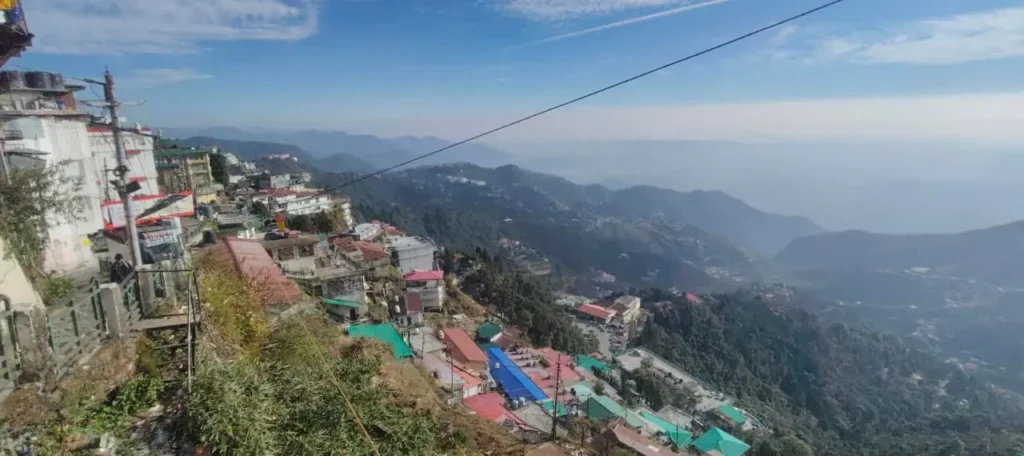
Almost every trip to Mussoorie begins and ends on Mall Road, and honestly, that’s not a bad thing. This roughly 3-km pedestrian-friendly stretch is closed to general traffic during the day, so it’s genuinely pleasant to walk — lined with cafés, woollen shops, and viewpoints that open up onto the Doon Valley below. Evenings here have a particular charm: the shops light up, street vendors sell roasted corn and hot jalebis, and there’s a steady hum of people just strolling without any particular destination in mind.
If you enjoy old buildings, keep an eye out for the colonial-era churches tucked just off the main road — Christ Church, believed to be one of the oldest churches in the Himalayan region, is worth the short detour. Book lovers should also swing by the Cambridge Book Depot, a long-running bookstore that’s become something of a Mussoorie institution.
2. Camel’s Back Road

Running roughly parallel to Mall Road, Camel’s Back Road is quieter, greener, and far less crowded — which is exactly why it deserves more attention than it usually gets. The road gets its name from a rock formation that resembles a camel’s hump, and the walk (about 3 km one way) offers some genuinely lovely views of the mountains without the noise of a market pulling your attention away. If walking the full stretch feels like too much, golf carts are available for hire along the route.
The unmissable stop here is Scandal Point, an old viewpoint with a bit of colonial-era gossip attached to its name, where you can usually find someone with a telescope offering a closer look at the snow-capped peaks on a clear day.
3. Gun Hill

At around 2,024 metres, Gun Hill is the second-highest point in Mussoorie and one of the best places for a 360-degree view of the surrounding valleys — on a good day, you can spot the Bandarpunch and Gangotri ranges in the distance. You can either take the 20-minute walking trail up from Mall Road or ride the ropeway, which takes about five minutes and is an experience in itself. Round-trip ropeway tickets typically fall somewhere in the ₹150–200 range, though it’s worth confirming the current rate at the counter since prices do get revised.
Once up top, there are small eateries for tea and snacks, and — if you’re in the mood — the chance to get your photo taken in traditional Garhwali attire, which is a fairly popular thing to do here.
4. Company Garden (Municipal Garden / Atal Udyan)
Roughly 3 km from Library Chowk, this landscaped garden was originally laid out in 1842 and remains one of the most family-friendly spots in Mussoorie. It’s now officially called Atal Udyan, though most locals and taxi drivers will still know it as Company Garden. Inside, you’ll find neatly maintained flower beds, a small boating lake, an artificial waterfall, and enough open lawn space to just sit down and do nothing for a while, which — after a day of walking — is sometimes exactly what you need. There’s a modest entry fee, and boating is charged separately.
5. Landour and Lal Tibba
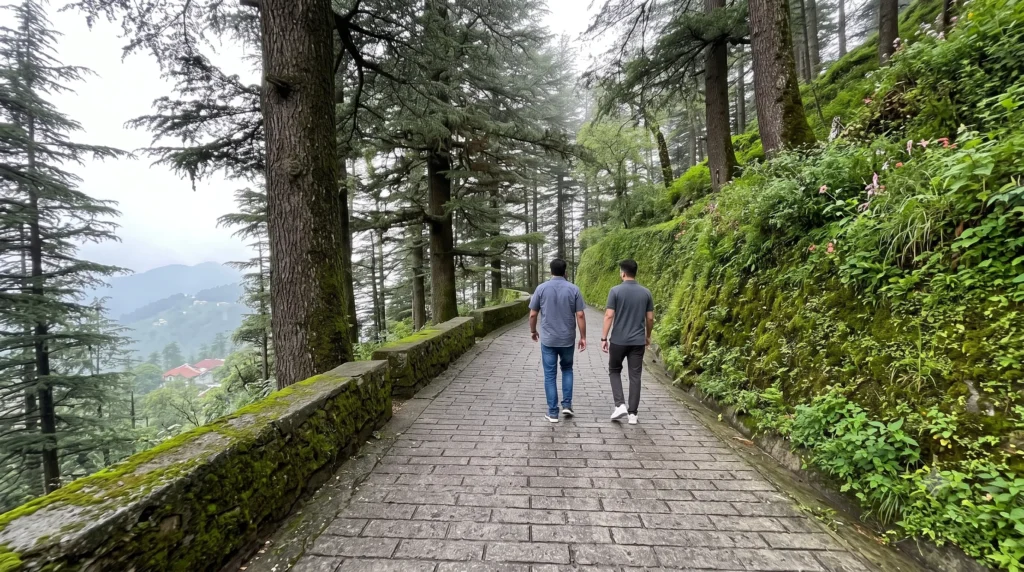

If Mall Road is Mussoorie’s busy front room, Landour is its quiet study. This is the older, higher part of town — a cluster of colonial-era cottages, pine forests, and a handful of legendary little cafés that have barely changed in decades. It’s the kind of place best explored slowly, ideally on foot or bike, with no fixed plan.
The core area — often called Char Dukan for its cluster of small eateries — is a good place to start. From there, wander toward Lal Tibba, Mussoorie’s highest point, best known for the rare optical phenomenon called the Winterline: a sharp orange band that appears on the horizon at sunset, most vivid in the winter months. It’s one of only a handful of places in the world where this occurs, alongside a few Himalayan spots and the Swiss Alps.
While you’re in Landour, don’t skip Sisters’ Bazaar, a tiny market with a couple of old-world cafés and bakeries that draw a steady stream of regulars, or the century-old churches scattered through the area if colonial history interests you.
6. George Everest House and Peak
This one surprises a lot of first-time visitors: the house where Sir George Everest — the man after whom the world’s tallest peak is named — lived and worked as India’s Surveyor General between 1830 and 1841. He never actually surveyed or discovered the mountain himself, which is a fun bit of trivia to drop on your travel companions. The property, about 5 km from Library Chowk, has been restored and now houses a small cartography museum.
From here, a fairly easy 1-km hike takes you up to George Everest Peak, with sweeping views over the Doon Valley and the Aglar river below — a good half-day outing, especially in the late afternoon when the light softens.
7. Happy Valley and the Buddha Temple
When the 14th Dalai Lama first left Tibet in 1959, Mussoorie’s Happy Valley area is where he settled before eventually moving to Dharamshala. A local Buddhist monastery, Shedup Choephelling, was established here in 1964 and remains an active center of worship and learning — it holds the distinction of being among the very first Tibetan monasteries built outside Tibet. A short hike above the valley leads to a large Buddha statue with panoramic views, making this an easy 2–3 hour visit that pairs history with a bit of exercise.
8. Kempty Falls
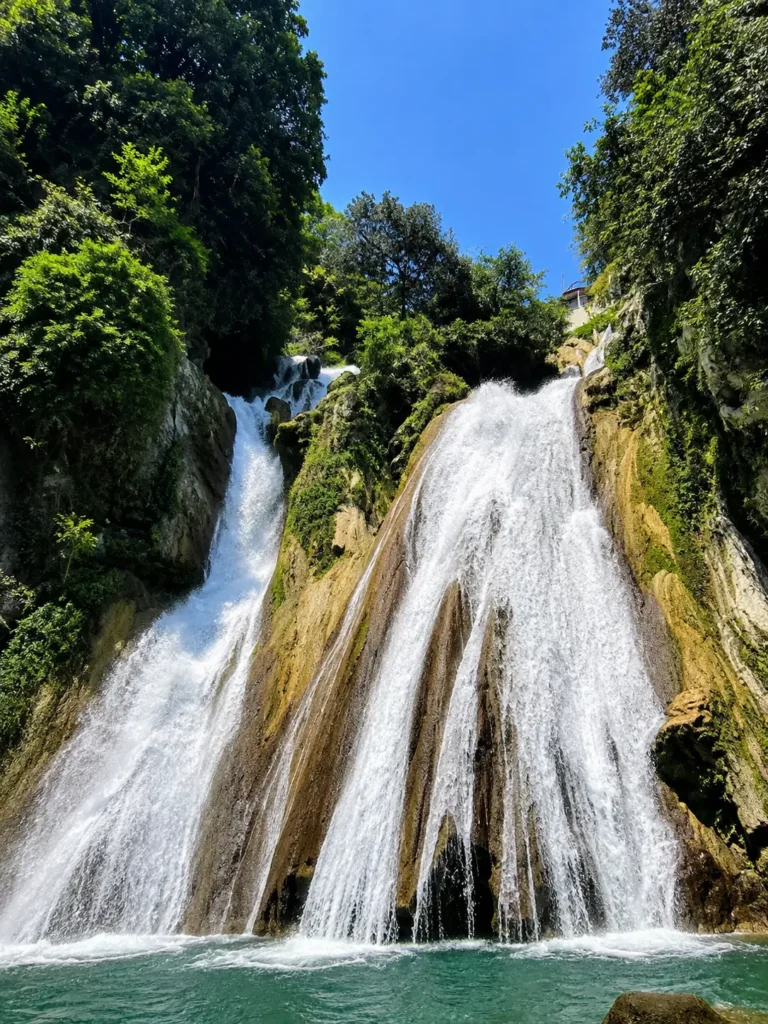
About 20 km from town, Kempty Falls is one of the most-visited waterfalls in the region — and yes, that means it can get crowded, especially between March and June. It’s a multi-tiered cascade, and you’ll need to walk down a flight of steps (over a hundred of them) to reach the pool at the base, where wading and splashing about is part of the appeal. If crowds aren’t your thing, aim for an early morning visit or consider one of the quieter waterfalls listed further below instead.
The Quieter, Less-Crowded Spots
Mussoorie gets genuinely busy during peak season (roughly March–June, and again around Diwali and New Year), and if you’d rather skip the crowds, these spots are worth building into your plan.
- Cloud’s End — About 8 km from Library Chowk, this is one of the oldest colonial-era properties in the region and offers a genuinely peaceful view of the Doon Valley with far fewer tourists. A quick note: search it on maps as “Cloud End Viewpoint Original,” since a few similarly named pins can send you to the wrong spot.
- Mussoorie Lake — A relatively new, man-made lake on the Dehradun road that’s become popular for boating and photography, without the density of crowds you’ll find at Kempty.
- Bhatta Falls — Roughly 10 km along the Mussoorie–Dehradun road, tucked just off the highway, this is a smaller but far more relaxed alternative to Kempty.
- Jharipani Falls — About 9 km south of town, this one’s genuinely tucked away and rarely makes it onto standard tourist itineraries, which is exactly its appeal.
- Sainji Village — A little further out (around 20 km), known locally for the distinctive sight of corn cobs strung up and drying outside every home.
Day Trips From Mussoorie
If you have an extra day, a couple of nearby towns are well worth the drive.
Dhanaulti (about 30 km) is quieter than Mussoorie itself, with the drive there being just as much a highlight as the destination — expect long, uninterrupted views of the Gangotri and Kedarnath ranges along the way. Once there, the Eco Park is a pleasant, low-key stop, and if you have time and energy, you can push on to Kanatal (about 15 km further) or even attempt Surkanda Devi Temple, one of the 51 Shakti Peeths, though that’s a fuller day trip on its own.
If you’re comfortable riding, renting a bike for the day (roughly ₹500–600) is a popular way to do the Mussoorie–Dhanaulti stretch — the curvy mountain roads and constant photo stops make it feel more like an adventure than a commute.
Things to Actually Do (Not Just See)
- Catch the Winterline sunset at Lal Tibba — best between November and February.
- Take a slow, unhurried walk through Landour with no fixed plan.
- Ride a pedal rickshaw down Mall Road in the evening.
- Pick up a Ruskin Bond book at Cambridge Book Depot — the author has strong ties to the region.
- Hike up to George Everest Peak for the views and the history lesson.
- Spend a lazy afternoon in Happy Valley.
- Take the ropeway to Gun Hill and dress up for a Garhwali-costume photo.
- Try a proper Garhwali thali at least once during your stay.
Where to Eat
Mussoorie’s food scene has grown well beyond the standard tourist fare. For an authentic Garhwali thali, look for smaller local eateries around Landour and Kulri Bazaar. Kulri Bazaar, generally, has a livelier café and restaurant scene compared to Library Bazaar, with everything from wood-fired pizzas to Tibetan momos and continental breakfasts. Landour’s old bakeries and cafés — some running since the British era — are worth a visit purely for the atmosphere, quite apart from the food itself.
Where to Stay
Mussoorie has accommodation for every budget, from heritage hotels with valley views to backpacker hostels near Library Chowk. If you’re travelling on a budget, look at stays around Landour or the Barlowganj side of town — they tend to be quieter and often better value than properties right on Mall Road, which command a premium purely for location. For a more premium stay, several colonial-style properties near the Mall offer a genuinely different experience — think wood-panelled rooms and views straight down into the Doon Valley.
Best Time to Visit Mussoorie
Mussoorie is often called an all-weather hill station, and it largely lives up to that.
- March to June: The most popular window, with pleasant daytime temperatures — but also the busiest, especially around holidays.
- July to September: Monsoon season. It’s quieter, greener, and genuinely beautiful if you don’t mind occasional rain and mist — a favourite among travellers who prefer their hill stations without the crowds.
- October to February: Cooler, clearer skies, and your best shot at catching the Winterline in December and January. Late December can bring light snowfall in some years.
How to Reach Mussoorie
- By Air: Jolly Grant Airport, Dehradun, is about 60 km away, with regular flights from Delhi and a few other major cities.
- By Train: Dehradun Railway Station, roughly 35 km from Mussoorie, is the nearest railhead and well connected to Delhi and other parts of North India.
- By Road: Regular buses run from Delhi to Dehradun, from where taxis, shared cabs, and local buses continue up to Mussoorie. Driving yourself is also a popular option, with the last stretch from Dehradun offering some genuinely scenic mountain views.
Getting Around Once You’re There
Mall Road and its immediate surroundings are best explored on foot. For Landour, Camel’s Back Road, or the outer attractions like George Everest and Happy Valley, a rented bike gives you the most flexibility, though taxis are widely available if you’d rather not deal with the narrow mountain roads yourself.
A Suggested Itinerary
2 Days: Mall Road and its churches on day one, evening at Camel’s Back Road; Gun Hill, Company Garden, and Landour/Lal Tibba on day two.
3 Days: Add Kempty Falls or George Everest on day three, depending on whether you’d rather see a waterfall or hike to a viewpoint.
4–5 Days: Spread things out — dedicate a full day to Landour alone, another to the offbeat spots like Cloud’s End and Jharipani Falls, and use your last day for a Dhanaulti day trip.
Final Word
Mussoorie rewards travellers who don’t try to see everything in one rushed day. The obvious spots — Mall Road, Gun Hill, Kempty Falls — are popular for good reason, but the real charm of the town often shows up in the quieter corners: an unplanned walk through Landour, an evening at Camel’s Back Road with almost no one else around, or a lazy afternoon in Happy Valley with the clouds rolling in. Plan a little, but leave room to wander — that’s usually when Mussoorie is at its best.
Frequently Asked Questions
How many days are enough for Mussoorie?
Three to four days comfortably cover the main attractions. Add a fifth if you want to include a day trip to Dhanaulti or explore at a slower pace.
What is Mussoorie famous for?
Its colonial-era charm, panoramic Himalayan views, Mall Road, and the rare Winterline sunset phenomenon at Lal Tibba.
Is Mussoorie good to visit in monsoon?
Yes — while some hill stations struggle in the rains, Mussoorie handles monsoon well. It’s quieter, greener, and a favourite time for travellers who enjoy misty weather, though landslide-related delays are occasionally possible on the approach roads.
Which is better, Mussoorie or Nainital?
Both offer very different experiences — Mussoorie leans more colonial and hilltop-viewpoint focused, while Nainital is built around its central lake. If you want walkable heritage lanes and mountain panoramas, Mussoorie edges it out for most travellers.
What should I pack for Mussoorie?
Layers, regardless of season — evenings get cool even in summer. Carry a light rain jacket if visiting between July and September, and warmer woollens for a winter trip.